
Posts Tagged: disaster risks


Final Conference: Large Appreciation for BORIS2’s Results
On December 11, 2025, the BORIS2 project held its final conference in Pavia, Italy, presenting its results and discussing how to make use of them in the future, i.e., how the BORIS2 methodology and platform can be used to support cross-border disaster preparedness for floods and earthquakes. The event (hosted by EUCENTRE) gathered the project team and external stakeholders from all over Europe. It was a great opportunity to showcase the project’s outputs to its stakeholders and end-users.

Setting the scene
After welcomes from Michele Lissia (Mayor of Pavia), Fabio Germagnoli (EUCENTRE), and Mauro Dolce (Consorzio Interuniversitario ReLUIS), Cristina Colaco (DG ECHO) spoke about capacity building tools for preparedness, and Azzurra Lentini (Joint Research Centre) spoke about the importance of building on science evidence to support disaster management. BORIS2 coordinator Maria Polese (CI3R) and Johanna Zweiger (DCNA) presented the overall objectives and dissemination efforts of the project.

Methodology, tools and pilots
Daria Ottonelli (CI3R) and Secer Keskin (TED University) explained challenges and gaps, e.g., regarding data collection, and Matjaz Dolsek (University of Ljubljana) presented the BORIS2 methodology (four steps for a harmonized framework for urban multi-risk assessment). This was followed by a presentation by Serena Cattari (CI3R) who explained how the project worked on overcoming its challenges and on practically applying the methodology. Valerio Poggi (OGS), René Kastner (DCNA), and Milena Ostojić (University of Montenegro) illustrated the three pilot applications for verifying the replicability, robustness, and practical usefulness of the approach. Finally, Marta Faravelli (CI3R) presented the new BORIS2 platform which integrates the project’s methodological results and their application in the pilot areas.
The way forward
The day ended with a roundtable discussion moderated by Mauro Dolce that included invited stakeholders from several European countries (Austria, Slovenia, Montenegro, Turkey, and Italy). The discussion highlighted the added value of a harmonised approach to multi-hazard risk assessment and the importance of cross-border cooperation, especially in areas characterised by shared infrastructure or natural phenomena with supranational dynamics.
The contributions that emerged underlined how BORIS2 represents a significant step towards more effective tools to support strategic decisions in emergency planning. The possibility of applying the methodology at the sub-municipal scale, together with the integration of critical infrastructure and multi-hazard assessment, enables more precise identification of the most vulnerable urban areas and operational priorities.
A big thank you to our hosts from EUCENTRE and all participants for joining!
More BORIS2 Results: Synergies and Integration of Existing Initiatives Within the UCPM
We are happy to share more results from our project: Deliverable D2.3 (Synergies and Integration of Existing Initiatives Within the UCPM) aims to investigate, identify and utilise synergies between the BORIS2 project and existing Union Civil Protection Mechanism initiatives. By considering the results of these initiatives, BORIS2 seeks to improve its methodologies, tools and frameworks for DRM, particularly for cross-border and multi-risk assessments. This report shows how existing projects and networks contribute to BORIS2 activities and promote a coherent approach to disaster resilience and emergency planning across Europe.
The report features a comprehensive review of past and current EU and UCPM-funded projects. This review includes a detailed examination of the objectives, outcomes and methodologies of these projects to identify overlapping objectives and complementary approaches. Understanding these initiatives allows us to identify approaches and outcomes that may be relevant to BORIS2. An important part of this process is the identification of common methods and tools used in these initiatives.

Tackling Urban Disaster Risks – Successful Webinar with Experts from Austria and Italy
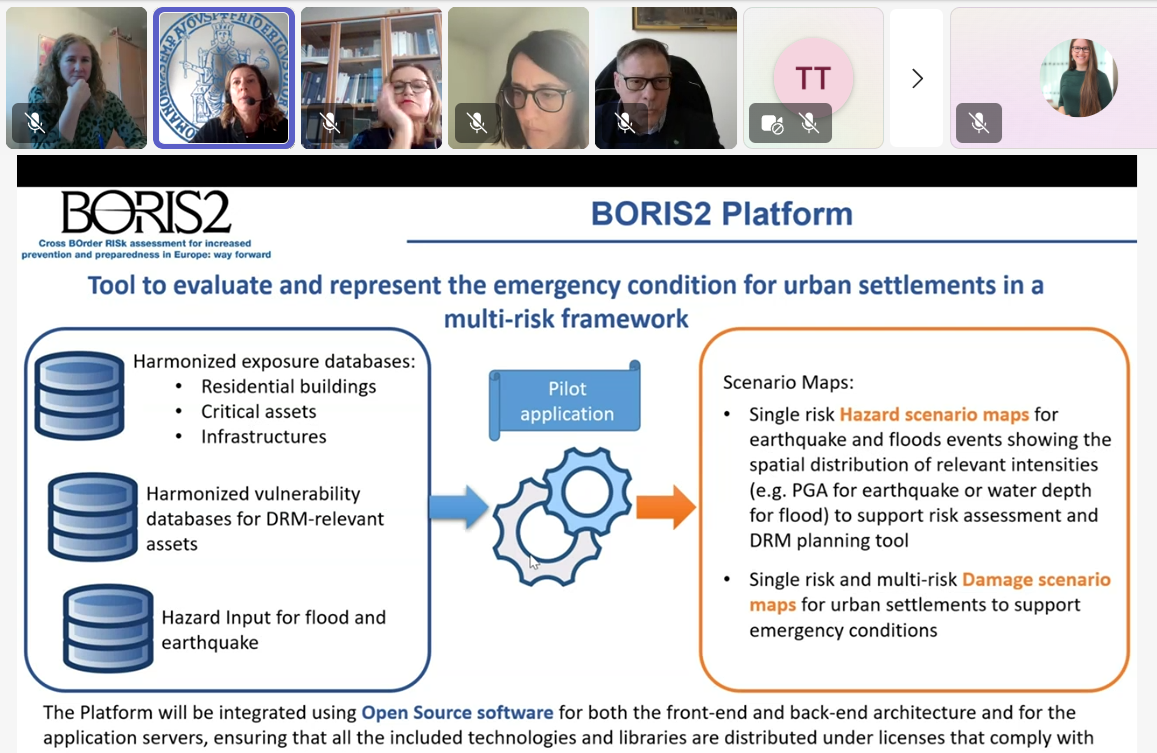
We were pleased to welcome more than 60 participants to today’s webinar on “Tackling Urban Disaster Risks: Barriers, Data Needs, and Frameworks in a Multi-Hazard Context”, organized by the Disaster Competence Network Austria. The webinar provided inputs from experts from Austria and Italy, and attracted participants from universities, research institutes, civil protection deparments and other organizations involved in cross-border-collaboration from all over Europe and beyond.
As part of the BORIS2 team, Maria Polese and Daria Ottonelli presented the project and the findings of work package 2 – context analysis and needs assessment. Our external speakers, then, provided practical inputs from their everyday work: Tanja Schriebl and Günter Hohenberger from the Office of the State Government of Styria, Austria, talked about the contingency plan for floods for the border (river) Mur and Elena Speranza from the Italian Civil Protection Department presented an overview on emergency planning and Italian civil protection tools.
Curious about the insights presented in the webinar? You can re-watch it here:
Find out more about the speakers of the webinar:
Maria Polese is associate Professor of Structural Engineering at University of Naples Federico II. As member of ReLUIS and CI3R, she is coordinator of BORIS2 and has led the WP3 – Good Practices and Scenarios of the EU Project ROADMAP2. She is also leader of the WP2 “Multi-risk-oriented modeling of urban systems” – of the spoke TS1 “Urban and Metropolitan Settlements” within Extended Partnership RETURN. She is expert in seismic vulnerability, risk/loss estimation methodologies, multi-risk assessment and crisis management policies framework.
Daria Ottonelli is a researcher in the Department of Risk Assessment and Loss Data at the CIMA Research Foundation. Daria is a Building Engineer and holds a PhD in Structural Engineering from the University of Genoa, where her research focused on assessing seismic performance and evaluating losses in unreinforced masonry buildings. Currently, her research centers on the risk and impact analysis of natural hazards, with a particular emphasis on floods, in both single and multi-risk environments. Her work involves characterizing exposure – including population, buildings, infrastructure, and services – by integrating global datasets with local information to enhance vulnerability assessments.
Tanja Schriebl studied civil engineering and water management at the University of Natural Resources and Life Sciences in Vienna, and works at the Office of the State Government of Styria, Austria, at the department for water management. Since 2022, she focuses on international water management, runoff analyses and hazard zone planning as well as water law procedures. She is a member of the Permanent Austrian-Slovenian Commission for the Mur river, and the steering committee of the five-country Mur-Drava-Danube Biosphere Reserve.
Günter Hohenberger studied at the University of Vienna, and obtained an M.Sc. in risk prevention and disaster management. He works for the Office of the State Government of Styria, at the Department for Civil Protection and Defense where he has been the head of the State Alarm and Warning Center since 2011, which is responsible for all types of crises and disasters in Styria. Before that, he worked in Planning and Response in civil protection. He is a member of the permanent Austrian Crisis Management Commission and also EUCP-trained.
Elena Speranza is an architect of the Italian Civil Protection Department with a specific background on seismic risk, seismic vulnerability and risk prevention issues. She is currently in charge of coordinating a specific unit of the Civil Protection Department for the governance of an extraordinary plan for vulnerability analysis of the Campi Flegrei area, instituted by law (DL 140/2023).